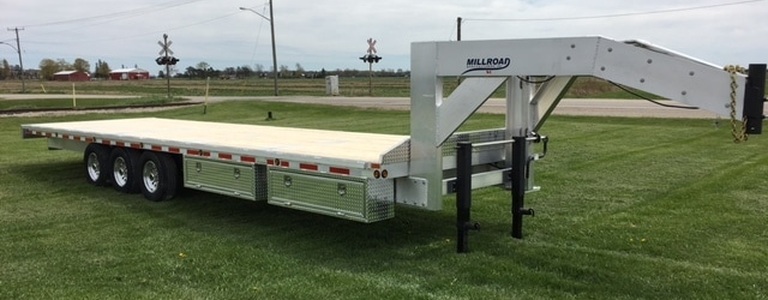
You may finish combining the last field, but the work around your farm does not stop. Fall brings equipment moves, storage work, repairs, supply runs, and winter preparation. A Millroad gooseneck farm trailer in Canada gives you an open hauling platform for handling these jobs when matched with the right truck, hitch, capacity, and loading setup.
You can use it to move both machinery and farm supplies after harvest. The long deck and available ramp options support different types of work, while the hitch position over the truck bed can provide stability for properly matched loads. The correct configuration depends on what you haul most often.
At Millroad Manufacturing in Brucefield, Ontario, we build gooseneck and fifth-wheel models for demanding commercial and farm work. We offer different deck styles, lengths, and custom options based on your needs. In this blog, we explain seven fall jobs a Millroad gooseneck can handle and what you should consider when configuring one for your farm.
Farmers can move equipment, attachments, maintenance loads, farm supplies, and building materials after harvest. These loads may support equipment storage, property repairs, winter preparation, and other work that continues after the fields are clear.
An open deck may provide more room and capacity than a smaller bumper-pull model. It can also support loads with unusual lengths or shapes. However, every item must fit the selected unit’s length, width, weight, axle, and tie-down limits.
Millroad offers gooseneck and fifth-wheel models with lengths of up to 40 feet and a bed width of 101 inches. You can choose a straight deck or a five-foot beavertail with flip-over ramps. Your tow vehicle, hitch, intended load, and applicable transport rules must all be considered before hauling.

Harvest equipment does not always remain in the field or farmyard once the crop is off. Some pieces need to enter storage, move to another property, or visit a service shop. A planned deck layout can make these moves easier to manage.
1. Move Field Attachments: You may need to move headers, buckets, blades, mower parts, or other attachments after harvest. These pieces can be long or awkward even when their weight falls within the selected capacity. You should account for their full dimensions, support points, and tie-down needs. A secure layout prevents one attachment from interfering with another part of the load.
2. Transport Compact Equipment: A suitable model may carry a compact tractor, skid steer, small excavator, or utility vehicle. A five-foot beavertail and flip-over ramps can provide a loading path when the equipment fits the chosen configuration. You must include fuel, loaded tires, attachments, and added parts in the total operating weight. Ground clearance and wheel or track spacing also affect loading.
3. Take Machinery for Maintenance: Fall is a practical time to move equipment to a dealer, mechanic, or welding shop. Service after harvest may identify worn parts before the machine enters winter storage. It can also help prepare equipment for the next working season. The chosen setup must support the complete machine as well as any loose parts travelling with it.
You should measure each machine in its actual transport position. A model name or basic listed weight may leave out attachments and other added equipment. Those missing details can change the type of configuration required.
Fall can provide time for infrastructure repairs after the busiest fieldwork is complete. A long, open platform gives you room for supplies that may not fit in a pickup bed. Careful placement keeps mixed loads balanced and secure.
4. Haul Fencing Supplies: Fence posts, gates, wire rolls, panels, braces, and tools can take up a large amount of space. Long items need a clear position that keeps them within applicable transport limits. Heavy pieces should be placed with overall load balance in mind. Every part must remain secured across farm lanes, rural roads, turns, and stops.
5. Move Pallets and Bagged Products: You may need to collect seed, soil products, bagged materials, containers, or other palletized supplies. A wide deck can provide useful loading room when suitable farm equipment is available. You should confirm the dimensions and combined weight of each pallet before pickup. Proper tie-down points help keep the full load in position during transport.
The farm’s common loads should guide the deck layout and optional features. Stake pockets, thick rub rails, D-rings, and other securement points can support different jobs. The selected features should match real hauling needs rather than take up useful space.
Winter preparation often requires supplies to be moved before snow or frozen ground makes access harder. Some loads come from a supplier, while others need to travel between farm properties. The available deck space may reduce the number of smaller trips when capacity allows.
6. Move Feed and Bedding: Fall may be the time to restock bagged feed, containers, bedding, or related supplies. Many smaller items can create a heavy combined load. The materials must remain protected, balanced, and secured during the trip. Their total weight must stay within the limits of the selected model and tow vehicle.
7. Haul Lumber and Repair Materials: Repairs to barns, sheds, gates, or other structures may require lumber, roofing, pipe, panels, and similar materials. An open deck can provide room for long pieces that do not fit inside a truck bed. You must consider load placement, overhang, and securement requirements. The unloading area also needs enough room for the truck and complete load.
These final jobs show how one hauling setup can support more than field equipment. It can remain useful for the repairs and supply runs that keep a farm operating through fall and winter.
Harvest may create some of the heaviest hauling needs, but farm work continues throughout the year. Different seasons bring maintenance, construction, supply, and equipment transport jobs. A well-chosen setup can move between these roles without being limited to one task.
The hitch connects within the truck bed instead of behind the rear bumper. This placement can support stability and control when the truck, hitch, and load are properly matched. It does not remove the need to follow vehicle ratings, axle limits, or safe loading practices.
Millroad uses aluminium construction to provide strength with a lower empty weight than comparable steel construction. Aluminium also resists rust and oxidation in wet conditions. The actual payload still depends on the model, axles, hitch, tow vehicle, and other selected features.
A gooseneck farm trailer in Canada can therefore become a year-round working asset. Its value comes from handling recurring farm work during several seasons. The key is selecting a configuration based on the farm’s complete workload.
Canadian fall weather may bring cold mornings, rain, mud, early snow, and shorter daylight hours. These conditions can affect the ground beneath the truck, ramps, and equipment. Loading should take place on a firm, level surface with enough space for the complete setup.
Some machines and materials should be moved before winter limits access to fields and storage areas. A farm lane that remains firm in early fall may become soft after several days of rain. Snow and frozen ground can create different access concerns later.
Aluminium resists corrosion, which can be useful during wet Canadian weather. However, the deck, hitch, ramps, tires, brakes, lights, axles, and tie-down equipment still require regular inspection and care. Weather resistance does not replace normal maintenance.
You should also plan how exposed supplies will remain protected. Feed, bedding, bagged products, tools, and building materials may need suitable weather protection. The chosen method must keep everything secure without exceeding the unit’s limits.
You should begin by identifying the heaviest, longest, and widest loads your farm expects to move. Record the full operating weight and dimensions of each machine. Include fuel, fluids, buckets, blades, loaded tires, and other attachments.
You will also need to choose between a straight deck and a five-foot beavertail with flip-over ramps. A straight deck may suit materials or equipment placed with suitable lifting machinery. The beavertail provides a sloped rear section for equipment driven onto the platform.
Millroad models are available in lengths of up to 40 feet with a bed width of 101 inches. Features include heavy-duty outside bed caps, thick rub rails, Dexter Torflex EZ Lube axles, LED lighting, and a five-year warranty. You can review our gooseneck and fifth-wheel models for more product information.
Published maximums do not apply to every configuration. Our team must match the deck, axles, hitch, ramps, and other features with your tow vehicle and intended work. The best model is the one that fits the farm’s actual loads.
Yes, when the tractor’s full operating weight and dimensions fit the selected model. Attachments, loaded tires, fuel, and added equipment must be included in the calculation. The wheel spacing and ground clearance must also suit the ramp and deck. Your truck and hitch need enough rated capacity for the complete load.
A beavertail has a sloped rear section that can create a more gradual path onto the deck. Flip-over ramps extend that path from the ground. This design may support equipment loading when its angle suits the machine. You still need to confirm ground clearance and capacity.
Millroad offers configurations with lengths of up to 40 feet. The right length depends on equipment dimensions, load balance, tie-down needs, and available turning space. You should also consider where the unit will be stored and loaded. A longer deck may not suit every farmyard or tow vehicle.
Both systems connect inside the truck bed, but they use different coupling designs. A gooseneck uses a ball connection, while a fifth wheel uses a plate-and-pin connection. Gooseneck hitches are often used for commercial and farm hauling. The right choice depends on the truck, intended work, and preferred hookup style.
Yes. Its open platform and available capacity can support work during several seasons. The most useful configuration will match both heavy equipment and the recurring materials your farm moves. This broader role can help turn the purchase into a year-round investment.
A productive fall does not end when the final field is complete. Equipment still needs to reach storage or service, farm infrastructure needs attention, and winter supplies must arrive before conditions become harder. The right hauling setup helps you complete these jobs without relying on several smaller solutions. It can also remain useful when new work appears during the rest of the year.
You should choose a model based on the farm’s real loads rather than one job alone. Deck length, width, capacity, hitch style, ramp setup, tow vehicle, tie-down points, and available manoeuvring space all matter. Your heaviest load may set the capacity requirement, but your most common jobs should shape the full configuration. This approach helps you choose equipment that supports several seasons of farm work.
At Millroad Manufacturing in Brucefield, Ontario, we build an aluminium gooseneck farm trailer in Canada and fifth-wheel models with straight-deck and beavertail options. Our team can review your equipment measurements, tow vehicle details, common loads, and hauling needs. We can then help you compare suitable sizes and features for your farm. Contact us to learn more about configuring a Millroad model that fits your yearly workload.